
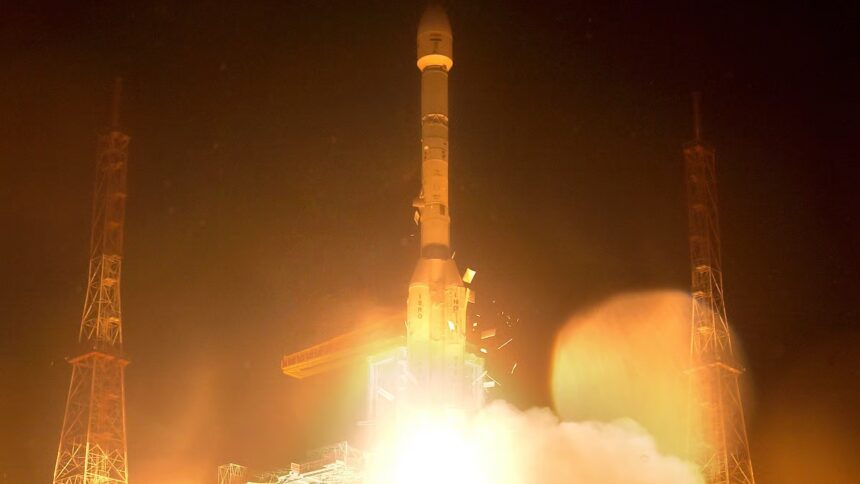

Sriharikota: The Indian Space Research Organisation (ISRO) has achieved a major milestone with the successful launch of the GSLV-F17 carrying the advanced Earth Observation Satellite-05 (EOS-05). ISRO Chairman V. Narayanan described the mission as a “great achievement” for India’s space programme and confirmed that the satellite is in “perfect health” following its successful injection into the intended orbit.
The GSLV-F17 lifted off at 2:55 a.m. on Friday, September 4, 2026, from the Second Launch Pad at the Satish Dhawan Space Centre in Sriharikota, Andhra Pradesh. The mission successfully placed the 2,367-kg EOS-05 satellite into a Sub-Geosynchronous Transfer Orbit (Sub-GTO). ISRO has described EOS-05 as India’s first dedicated imaging satellite intended to operate from a geosynchronous orbit.
Addressing the team after the successful launch, ISRO Chairman V. Narayanan said the GSLV-F17 had successfully and precisely injected EOS-05 into its intended orbit.
Narayanan said the satellite was functioning normally and that its health was “perfectly alright” after separation from the launch vehicle. He also confirmed that the satellite’s solar panels had been deployed successfully, marking an important early milestone in the spacecraft’s post-launch operations.
The ISRO chief highlighted the significance of the mission, particularly because EOS-05 is designed to provide advanced Earth-imaging capabilities from a geosynchronous platform. According to ISRO, the spacecraft represents a new step in India’s Earth-observation programme.

Heaviest Satellite Carried by the GSLV-F17
One of the key achievements of the mission was the successful deployment of the 2,367-kg EOS-05, the heaviest satellite carried by this GSLV launch vehicle configuration, according to Narayanan.
The GSLV-F17 mission is also the 19th flight of India’s Geosynchronous Satellite Launch Vehicle (GSLV). The successful performance demonstrates the continuing development of the launch vehicle’s structural and propulsion capabilities and strengthens India’s ability to place heavier spacecraft into higher orbits.
EOS-05 is an advanced Earth-observation spacecraft designed to provide imaging capabilities from a geosynchronous orbit. Unlike conventional Earth-observation satellites operating in lower orbits, a spacecraft positioned in a geosynchronous orbit can maintain a much broader and more persistent view of large areas of the Earth.
Once fully operational, EOS-05 is expected to provide valuable data for several national applications, including Earth observation, disaster management, infrastructure monitoring, agriculture, environmental monitoring and other strategic requirements. Reports on the mission have also highlighted its potential importance for large-area and near-real-time imaging.
Successful Mission After Extended Gap
The GSLV-F17 launch also carried significance for ISRO because it marked the return of the GSLV platform to flight after an extended gap. The successful mission is expected to reinforce confidence in the launch vehicle and India’s ability to undertake complex missions involving heavy satellites and higher orbits.
The mission comes at an important stage for India’s space programme, with ISRO pursuing a broader series of launches and ambitious human-spaceflight and satellite programmes.
Narayanan credited the successful mission to the collective efforts of ISRO scientists and engineers, industrial partners and academic institutions.
He also acknowledged the contribution of former ISRO leadership and the families of personnel involved in the programme, emphasising the organisation’s collaborative working culture and extensive review mechanisms.
The successful launch demonstrates the importance of cooperation between India’s space agency, domestic industry and academic institutions in developing and operating increasingly sophisticated space systems.
Six More Launches Planned
Looking ahead, ISRO is preparing for an active launch schedule. Narayanan said the organisation is targeting six more launches during the current financial year.
Among the programmes being prepared is an uncrewed Gaganyaan mission, which is expected to be an important step in India’s human-spaceflight programme. The planned missions underline ISRO’s broader objective of expanding India’s capabilities across Earth observation, communications, science and human spaceflight.
Prime Minister Narendra Modi also congratulated ISRO scientists and engineers following the successful launch, describing the achievement as a matter of national pride and recognising the contribution of India’s space scientists to the country’s technological progress.
The successful deployment of EOS-05 therefore marks an important chapter in India’s expanding space capabilities and provides further momentum to the country’s ambitious space roadmap.